I try to do a round of fecals for the goats before winter every year. This is the best way to get a clear picture of their digestive health.
Goats are animals that naturally carry a parasite load. The goal is to be free of the bad parasites, and to have the normal ones within a healthy range.
I decided to do my own fecals when I realized that all I needed was a microscope and a special slide. I already had the microscope from teaching my kids biology, and this gave me a perfect excuse for pulling it out! And it’s super cool to have a working knowledge of exactly what’s going on with each animal out there in my goat barn.
Winter is the hardest season on my goats. I have goats that are a little too used to the good life. When there is snow on the ground, they won’t even leave the barn. And when the barn floor is solidly frozen over with the deep bedding method through the winter, well, I sort of wish they WOULD go out and at least enjoy some fresh air. But they don’t. (Even if I shovel part of the pasture for them, the prefer to keep their dainty little hooves dry and comfy in their barn.)
So, going into winter, I like to do a health check, making sure each goat is at its healthiest. The most time-consuming part of that health check is the fecals.
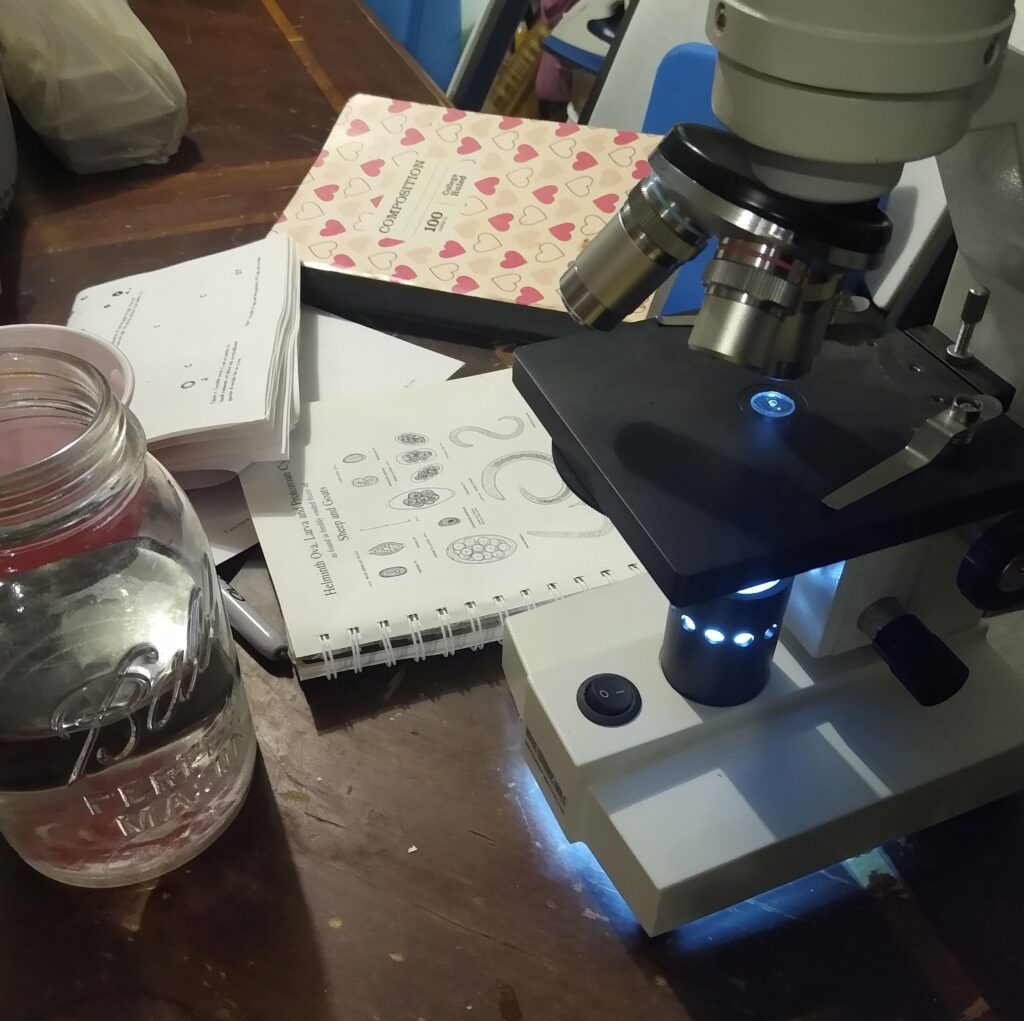
The process is called the Modified McMaster Fecal Egg Counting Procedure, and it is pretty straightforward. I just go through each step and do what it says. Basically, you’re taking a small amount of fresh goat poop, mixing it with some salt water (which you can also make!), straining it, and looking at the strained material under the microscope.
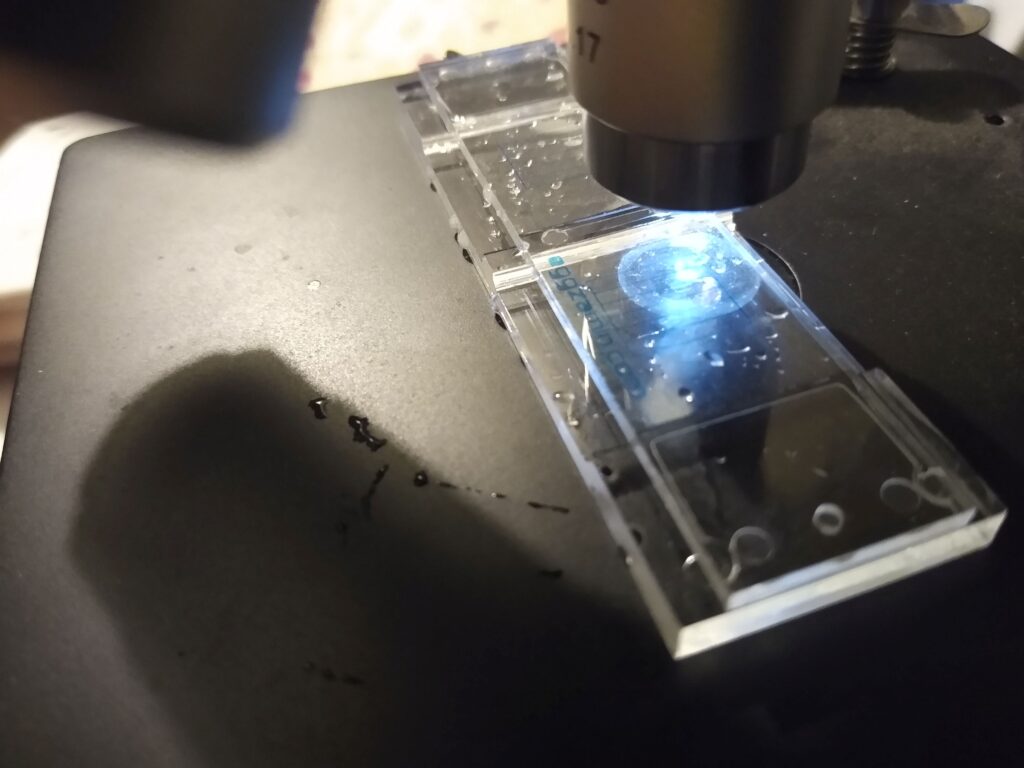
This is a clean (rinsed) slide. You can see that there is a large gap between the top and the bottom of the slide, to put your sample in. Parasite eggs rise in the salt water! So then you just focus in on the top, and count the eggs you see. There is a grid to help you work through the whole thing.
I have a McMaster slide somewhere, but when I went to do the fecals this fall, I couldn’t find it. I had to buy a new one, but the name-brand slide was out, and I had to settle for another one made by Eggzamin. It worked just as well.
When you’re done counting eggs, you work a little math to calculate how many eggs you have per gram of poop, to give you a nice, steady number to work with and compare.
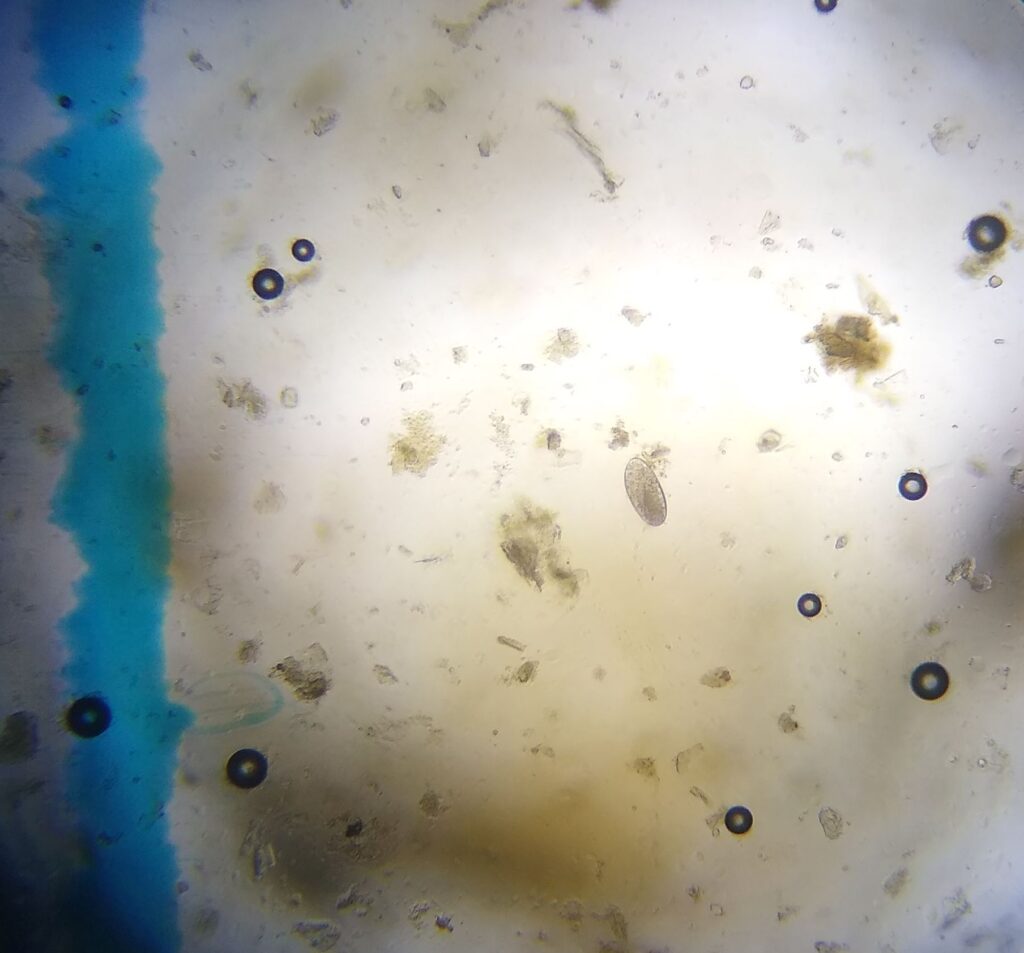
I did find one strongylid egg, and some coccidia, but not enough to be concerned with.
Most of what you see is plant matter from they hay they eat. The dark black circles are air bubbles. That oval thing right in the center is the strongylid egg.
The beauty of doing the fecals is that if there was a problem, I could then treat WITH THE APPROPRIATE MEDICINE, and then re-test, to see exactly what effect it had. Notice in this whole scenario I am NEVER just guessing, and treating broadly for something they may or may not have. This means I’m treating the RIGHT thing, and also my goats aren’t becoming resistant to other meds, so that if they ever need them, I will still have an arsenol of effective medicines to use!
A lot of well-meaning people manage their goats by regularly worming, and, while you may be able to raise healthy animals with this method, it is BEST to look at what is actually going on, and only treat as indicated.
When I have done my fecals, I have done them on healthy animals. If you have a sick animal, please know there is something wrong, and you do need to get answers very quickly. (Goats don’t usually give a lot of warning, even when sick enough to die, so take everything seriously!) If you run a fecal, and it comes up empty, it is possible your goat still has a parasite, and it just wasn’t shedding at the time you took the sample. Test again! And pursue all possibilities until you know what is wrong with your animal.
Finally, if you’re here because you’re ready to dive in and start doing your own fecals, I have one last comment. Mine microscope only has one little part to look in. If I had it to do again, I would DEFINITELY pick a binocular microscope, so I could look into it with both eyes. 🙂 Holding one eye closed for so long is really annoying. (Just not quite annoying enough to justify buying a new microscope!)